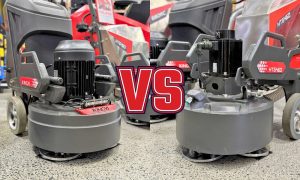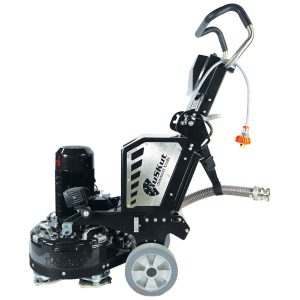
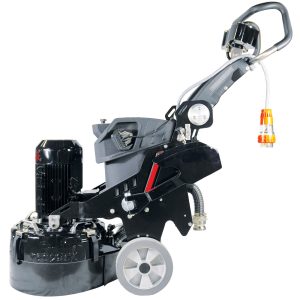
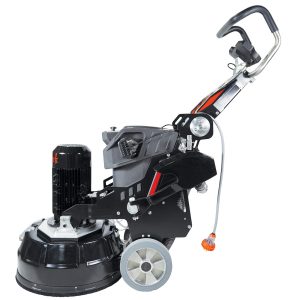
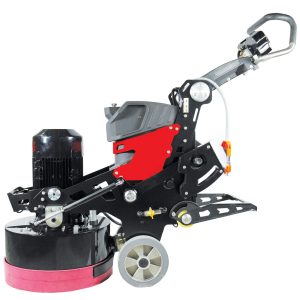
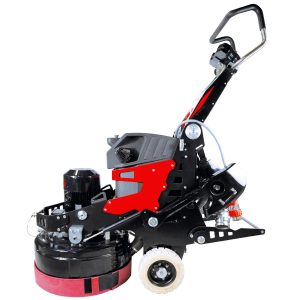
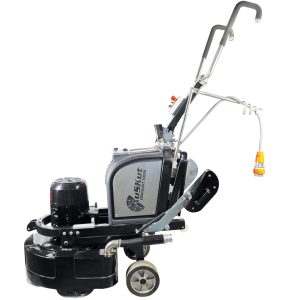

When you’re running floor grinding jobs with a planetary grinder, your pressure configuration isn’t something to just set and forget. Getting the pressure right makes a massive difference in how fast you move across a slab, how smooth the finish looks, and how long your diamond tooling lasts.
Whether you’re levelling slab inconsistencies or chasing a high-polish finish, pressure is what gives you control. Too heavy and you’ll glaze segments, burn diamonds and scar the floor. Too light and you’ll waste passes without cutting properly. The right setup keeps your tools alive and your workflow steady.
Planetary grinders run multiple rotating heads under a large central plate. That spreads the weight more evenly than single-head machines and gives better coverage. But even the best machine will struggle if the pressure isn’t tuned properly.
On Redback planetary grinders, pressure adjustment is simple:
Swing weights – fold them over the heads to apply more downward force, or swing them back to lighten up.
Redi-Lock count – running fewer shoes on the plate increases pressure per segment, while a full set spreads load and eases pressure.
This affects:
Cutting depth – how aggressively the diamonds bite.
Scratch pattern – the consistency of the grind.
Heat and glazing – pressure directly impacts segment temperature.
Machine load – too much pressure stresses motors and bearings.
Hard, high-MPA slabs or older patched floors often need more bite. Softer or green concrete is already abrasive — too much pressure there will eat through tools in no time. The golden rule: run the least amount of pressure that still gives clean, even contact.
Pressure issues often show up in your tooling or finish before you notice them in the machine. Watch for:
Uneven tool wear – one side of a shoe worn flat while the other still has life.
Patchy finish – light and dark zones, uneven gloss, swirl marks.
Vibration or rattling – unbalanced load making the grinder jump.
Machine running hot – heads or casing heating up quickly, especially on coarse grits.
Slow progress – heavy feel without actual removal.
Every slab reacts differently, so don’t lock in your setup until you’ve seen how the grinder behaves. A quick check at the start saves hours later.
Test patch – sink the donut, run a short section, and check how the machine cuts.
Adjust Redi-Locks – if it’s too aggressive, add more shoes to spread the load; if it’s skating, pull a few off to increase bite.
Check balance – look at the finish in the patch and behind the machine. Use a straight edge to spot highs or uneven cut.
Listen and feel – smooth glide means you’re on track; dragging, rattling, or chattering means something needs adjusting.
Grinder pressure isn’t about guessing — it’s about watching how the floor reacts and making small changes until it feels right.
Planetary grinders do the heavy lifting on open floors, but edges and tight corners always call for handheld tools. Keeping the right Auskut blades and cup wheels in your kit makes sure the finish stays consistent.
Bond matching – Auskut’s colour-coded system makes bond choice simple. Hard floors need softer bonds (pink, blue, black). Soft or green concrete needs harder bonds (green, yellow, white). Wrong bond = glazed diamonds or wasted segments.
Turbo-style cup wheels – excellent on hard concrete and stone.
Grit range – run coarse cups for removal and finer cups to blend edges with planetary passes.
Dress glazed tools – if shoes or cups are smooth to touch, they’re not cutting. A quick re-dressing can help to bring them back.
Let the blade work – pushing harder doesn’t cut faster; it just makes heat and shortens life.
That way, when the edges and corners are finished, they blend in with the main grind instead of looking patched.
Once the floor’s done, don’t just park the grinder. Reset for the next job:
Clean heads and clear dust out of the frame.
Inspect shoes and segments for uneven wear.
Even five minutes of easy maintenance prevents issues on the next site.
Remember — pressure shifts as tooling wears and slabs change underfoot. Stay alert, make necessary adjustments as you go, and you’ll get better finishes, longer tooling life, and faster jobs every time.
At Auskut Diamond Tools, we support you with Redback planetary grinders, Redi-Lock shoes, cup wheels, and cutting blades matched to Australian floors. With the right setup, you can get consistent, professional results on every slab.

Sign up to our email newsletter and we’ll send you a 10% discount code for your next order. No spam. We hate it as much as you do. Unsubscribe anytime.
10% off eligible products on orders up to $300. One use per customer.
Terms and conditions apply.