


Exposed aggregate concrete has been a staple of Australian driveways, pathways and outdoor entertaining areas for decades.
And for good reason.
It’s affordable, durable, naturally slip-resistant and doesn’t require the ongoing maintenance of many decorative concrete finishes.
That’s why you’ll find exposed aggregate on everything from older suburban driveways through to modern housing estates and new builds across Australia.
But while exposed aggregate is practical, it’s not always everyone’s favourite finish.
The rough pebble texture can be uncomfortable under bare feet. Loose stones can begin to appear over time. Dirt and grime can become trapped between the exposed aggregate. And let’s be honest – the look that was popular twenty years ago isn’t always what homeowners want today.
Increasingly, homeowners are choosing to grind exposed aggregate surfaces to create a smoother, flatter and more modern finish.
The transformation can be dramatic.
A rough pebbly driveway or outdoor area can be converted into a clean, high-end architectural surface that looks more at home on a luxury custom build than a suburban driveway.
The problem?
Exposed aggregate is one of the harshest surfaces you’ll ever ask diamond tooling to grind.
Most concrete grinding applications involve relatively smooth concrete.
Exposed aggregate is completely different.
Instead of a flat slab, you’re asking your tooling to travel across thousands upon thousands of raised stones.
Every one of those stones creates impact.
As the grinder moves forward, the segments aren’t simply cutting concrete. They’re repeatedly striking exposed aggregate that sits proud of the surrounding cement paste.
The rougher the aggregate profile, the more punishment the tooling receives.
This creates several common problems:
Older exposed aggregate driveways are often the worst offenders.
Many have bigger and heavily exposed pebbles that create constant impact loading on the tooling.
This is why many tradies discover very quickly that standard diamond tooling simply isn’t designed for this application.
When most diamond tooling is designed, the primary focus is on cutting concrete efficiently.
Exposed aggregate introduces a completely different challenge.
The diamonds are no longer just grinding concrete. They’re constantly absorbing impact from raised stones, pebbles and aggregate.
The issue often isn’t the diamond itself.
It’s the punishment the segment takes getting there.
Many standard segments simply weren’t designed to withstand this kind of continuous impact loading.
Over time, this can lead to rapid wear, inconsistent performance and reduced productivity.
That’s why tradies often end up searching for tooling specifically built for the application rather than relying on your usual concrete diamonds.
The reality is that exposed aggregate isn’t just another concrete surface.
It’s one of the harshest environments a diamond segment can encounter.
The problem usually isn’t that the aggregate is difficult to cut.
The problem is the punishment the tooling receives while doing it.
Every raised pebble and exposed stone creates impact. Thousands upon thousands of tiny hammer blows are transferred into the segment as the grinder moves across the surface.
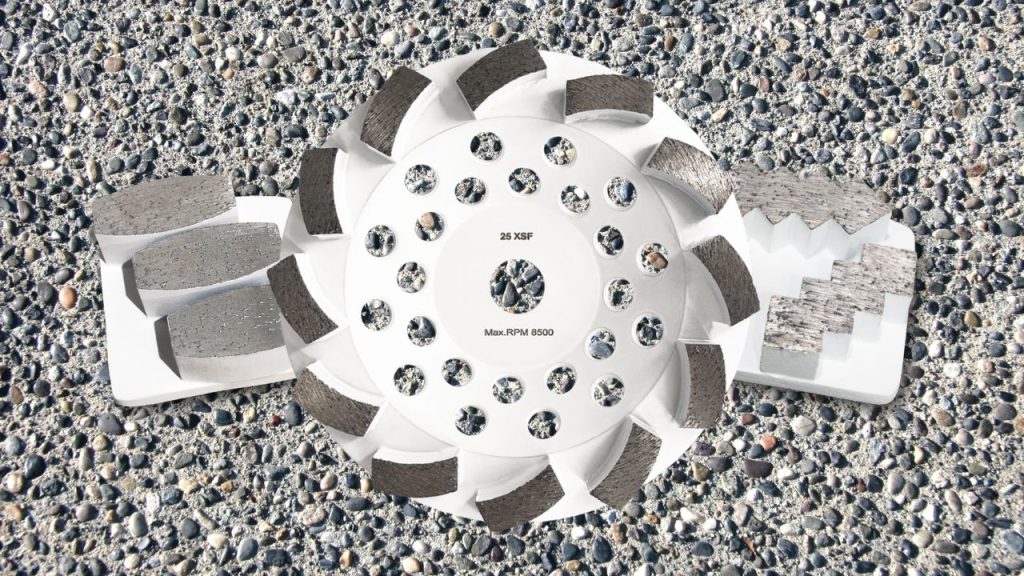
That’s exactly why Auskut developed a dedicated exposed aggregate tooling range consisting of:
These products weren’t adapted from general-purpose tooling.
They were specifically developed for aggressive exposed aggregate applications.
One thing that often causes confusion is the name.
XSF stands for Extra Soft Floor.
Many tradies assume this means the tooling has a softer bond.
In reality, it’s the opposite.
In diamond tooling, floor hardness and bond hardness work against each other.
Soft floors generally require harder bonds.
Hard floors generally require softer bonds.
The XSF range was developed around extremely aggressive exposed aggregate surfaces where impact resistance and durability are critical.
That’s why the bond is designed to withstand the constant punishment created by raised stones and pebbles.
The goal isn’t simply to cut exposed aggregate.
The goal is to survive thousands of impacts while continuing to grind efficiently.
The XSF Triple White Coffin is one of Auskut’s most popular exposed aggregate tools.
At first glance, the oversized triple-segment design looks different to many standard Redi Lock diamonds.
That’s because it was designed differently.
The wider footprint helps bridge across exposed stones rather than constantly dropping between them.
This creates:
The increased segment height also means more usable diamond material, helping tradies get more life from every set.
For tradies grinding exposed aggregate driveways, the Triple White Coffin has become a proven favourite.
If the Triple White Coffin was built for exposed aggregate, the Extra Wide Double White Step Segment was built for the really ugly stuff.
You know the jobs.
Old pebblecrete driveways.
Large stone aggregate.
Surfaces where the stones sit high above the surrounding concrete and everything wants to vibrate.
These are the applications where the Extra Wide Step Segment shines.
The oversized footprint helps distribute impact loads more evenly while providing excellent stability across uneven aggregate profiles.
Many tradies describe them as making the grinder feel more planted and controlled on rough exposed aggregate surfaces.
Combined with the hard-wearing XSF bond and additional segment height, they’re purpose-built for some of Australia’s most aggressive driveway and outdoor concrete surfaces.
Every exposed aggregate project eventually comes down to the edges.
And that’s often where things become frustrating.
Hand grinders naturally transfer more vibration into the operator, and exposed aggregate can make edge work slow and uncomfortable.
That’s why Auskut’s XSF White Cup Wheels were developed using the same philosophy as the Redi Lock range.
Wide segments.
Hard-wearing bond.
Excellent impact resistance.
Outstanding durability on exposed aggregate surfaces.
Whether you’re working around walls, garden edging, pool surrounds or tight access areas, the XSF White Cup Wheel helps achieve a consistent finish between the edge work and the main grinding area.
The biggest endorsement of any diamond tooling isn’t marketing.
It’s repeat orders.
Every week, Auskut ships XSF Triple White Coffins, Extra Wide Double White Step Segments and XSF White Cup Wheels to tradies across Australia tackling exposed aggregate projects.
Many of those customers have already tried standard tooling.
They’ve experienced excessive wear.
They’ve fought machine vibration.
They’ve burnt through segments faster than expected.
Then they find tooling that was actually designed for exposed aggregate.
That’s why these products have built such a loyal following among tradies who regularly transform rough exposed aggregate into smooth, modern, luxury-looking concrete surfaces.
Every slab is different.
But when it comes to grinding aggressive exposed aggregate, there are good reasons why so many Australian tradies reach for Auskut’s XSF range.
The XSF Triple White Coffins, Extra Wide Double White Step Segments and XSF White Cup Wheels weren’t designed to be general-purpose diamonds.
They were designed specifically for the impact, punishment and constant abuse that exposed aggregate surfaces create.
And when your goal is transforming a rough, pebbly driveway into a smooth, modern, high-end finish, having the right tooling can make all the difference.

Sign up to our email newsletter and we’ll send you a 10% discount code for your next order. No spam. We hate it as much as you do. Unsubscribe anytime.
10% off eligible products on orders up to $300. One use per customer.
Terms and conditions apply.